

English
High Pay Only on Paper? 10 Pitfalls When Hiring Foreigners in Poland
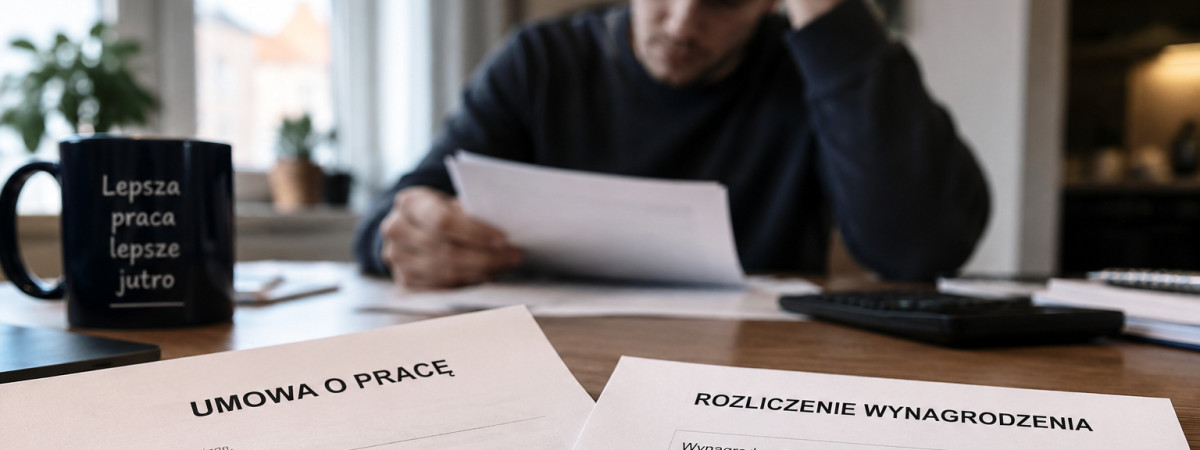
Hidden employment terms Yavp - Ilustracja AI
An attractive rate in a job offer, followed by a much lower salary. Part of the pay depends on bonuses, the employee is not registered with ZUS, and money for accommodation or transport is unexpectedly deducted from the salary. These are only some of the problems that foreigners looking for work in Poland may encounter. Gremi Personal identifies 10 practices that candidates should pay particular attention to.
At the end of 2025, more than 8,200 employment agencies were registered in Poland. Competition for workers is high, so job offers often attract candidates with high rates and favourable conditions. The problem begins when the information in the advertisement does not match the terms of the contract or the actual amount the employee receives after being hired.
International employment company Gremi Personal analysed candidates’ inquiries over the past six months and identified 10 practices that foreigners encounter when seeking employment in Poland.
At the same time, Polish state institutions are increasingly closely monitoring the legality of foreigners’ employment. Violations by an employer or agency may mean not only problems with pay, but also difficulties with documents and legalising one’s stay.
<em>This material was prepared in cooperation with Gremi Personal.<\/em>
1. Part of the salary paid “under the table”
One of the riskiest practices is when part of an employee’s salary is paid officially, while the rest is promised in cash.
For example, the documents may state a salary of PLN 4,806 gross, while the employee is supposed to receive another PLN 1,500–2,000 unofficially.
The risk is obvious: the unofficial part of the salary may simply not be paid. In addition, social security contributions are calculated only on officially declared income.
Violations may also be discovered during an inspection. Polish institutions have information about an employee’s registration with ZUS and the payment of contributions. If the official data do not correspond to the actual working conditions, this may raise additional questions.
2. No registration with ZUS
Another warning sign is when an employee is not registered with ZUS or the health insurance system, even though they should be insured under the type of contract concerned.
A foreigner may be told that all formalities will be completed later or that they can work for the first month without registration.
Often, the problem becomes apparent only when the employee falls ill, visits a doctor or checks the information in their personal ZUS account.
If an agency does not properly arrange social insurance, it is worth checking other employment-related documents more carefully as well.
3. Forged medical documents
Another dangerous practice is an offer to arrange the required medical documents without undergoing the appropriate examination.
An employee may be told that there is no need to “waste time” on a medical examination because the required certificate can be obtained another way.
For a foreigner, this may have serious consequences. If a forged document is used during employment or in procedures related to legalising one’s stay in Poland, problems with documents may arise.
Using forged documents may also result in criminal liability.
4. Manipulation of tax residency
An employee may be persuaded to sign a statement claiming that they are not a Polish tax resident, even though their actual situation indicates otherwise.
However, tax status is not determined solely by a signed declaration. What matters, among other things, is where a person’s centre of vital interests is located and how much time they actually spend in Poland.
If the data in the documents do not correspond to the actual situation, the tax authorities may require a corrected tax return and payment of outstanding tax together with interest.
Tax debts may also create additional difficulties when applying for documents allowing a stay in Poland.
5. Fictitious student status
A dishonest agency may offer to register an employee as a student even though they do not actually have that status.
The reason is simple: financial gain. Under certain conditions, a student under the age of 26 working under an umowa zlecenia contract does not pay part of the social security contributions. For the employer or agency, this means lower costs.
It is particularly dangerous if fictitious student status is also used in documents related to the right to work or stay in Poland.
In the event of an inspection, authorities may verify not only whether the student status is genuine, but also whether the employment during the relevant period was lawful.
6. The job offer lists a maximum rather than guaranteed rate
One of the most common problems concerns the way the salary is presented.
In a job offer, a candidate may see a rate of, for example, PLN 35–36 per hour and assume that this is exactly how much they will earn. After being hired, it turns out that the guaranteed amount is lower and the advertised rate can only be received if certain conditions are met.
Therefore, before starting work, it is necessary to clarify which rate is guaranteed by the contract and what the remaining part of the payment depends on.
If the information in the job offer, the contract and the actual salary calculation differs, this is a reason to examine the employment terms more carefully.
7. A significant part of the rate is actually a bonus
A similar situation arises when an attractive rate consists largely of a bonus.
For example, a job offer states PLN 36 per hour. However, the guaranteed rate is PLN 20, while the remaining PLN 16 is paid only if additional conditions are met, such as perfect attendance.
Sick leave or a missed shift can significantly reduce the monthly salary in such a case.
Before signing the contract, it is worth asking directly which part of the stated rate is guaranteed, which part is a bonus, and under what circumstances the employee may lose it.
8. Manipulation of working time records
Another problem is incorrect recording of hours worked.
An employee may actually work 220 hours but see only 180 on their payslip.
Sometimes individual shifts, time spent preparing for work or other periods are not counted. Formally, the hourly rate remains unchanged, but the total payment becomes significantly lower.
That is why it is worth keeping your own record of the number of hours worked and regularly comparing it with the employer’s calculations.
9. No extra pay for overtime and night work
It is worth paying attention not only to the basic hourly rate, but also to how overtime, night shifts and weekend work are paid.
The problem arises when all hours are paid at the same rate.
For example, a person working under an umowa o pracę employment contract may work 10–12 hours a day but not receive the legally required supplements for overtime or night work.
Over the course of a month, this may mean losing a noticeable portion of the salary due.
10. Unexpected deductions from salary
An attractive rate in a job offer does not always mean an equally attractive amount after payment.
After the first month, an employee may find that money for accommodation, transport, work clothing or other services has been deducted from their salary.
Various types of “fines” and additional charges that the candidate was not informed about during recruitment should be a particular cause for caution.
Before starting work, it is worth clearly establishing which costs are covered by the employer or agency, and which will be deducted from the salary and in what amount.
Do not look only at the rate
One of the biggest mistakes when comparing job offers is focusing exclusively on the hourly rate. A difference of a few zlotys means little if part of the salary depends on difficult-to-meet conditions, additional amounts are deducted from the payment, or issues arise with the legality of employment.
Before signing a contract, it is worth checking not only the salary amount, but also the type of contract, bonus calculation rules, the method of recording working time, registration with ZUS and all possible salary deductions.
It is also important to verify the reliability of the agency or employer itself.
— <strong>Today, a risky job offer does not necessarily look like a scam. It may have a good rate, a normal job description and a standard contract. The problem often becomes apparent later, when additional deductions appear, the salary amount changes or questions arise regarding documents. That is why we advise checking not only the job offer itself, but also the agency, its reputation, experience and the conditions it actually offers<\/strong>, Gremi Personal notes.
The Polish labour market is increasingly closely monitored in terms of the legality of foreigners’ employment. However, this does not mean that dishonest practices have disappeared. Often, they simply become less obvious.
Therefore, the safest job offer is not necessarily the one with the highest stated rate, but the one where the conditions are clearly described and correspond to the documents signed by the employee.
Selected for you
